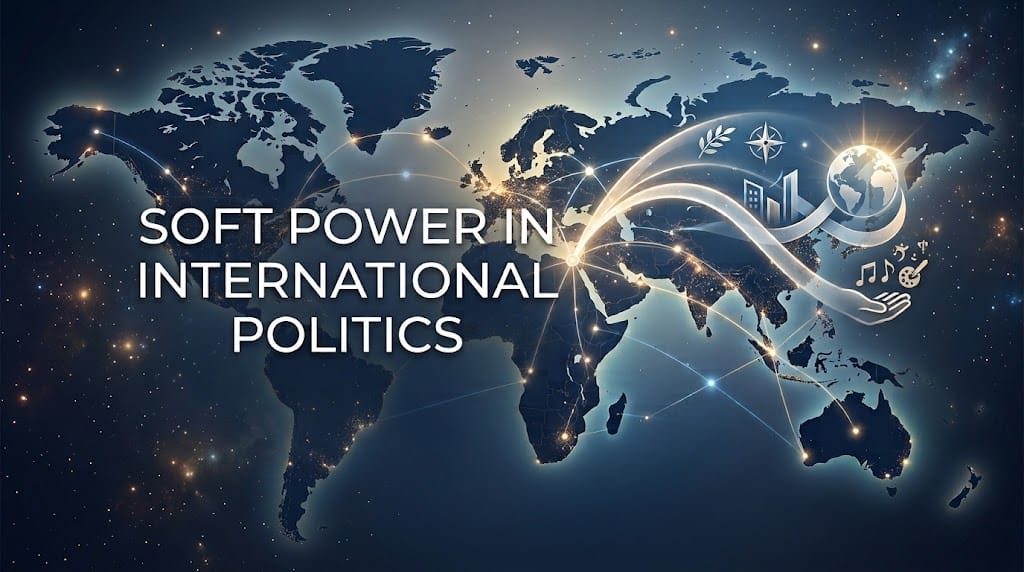
SOFT POWER IN INTERNATIONAL POLITICS
Soft power is a nation’s ability to influence others through attraction rather than coercion or economic pressure, using culture, ideology, education, diplomacy, and reputation.
Published 2 months ago
INTRODUCTION
It refers to the ability of a nation to have an impact on other nations using means that are not either coercive or economic in nature. In such a case, the nation is able to attract other nations through cultural, ideological, educational, diplomatic, and reputational ways.
The concept of soft power has been coined by American political scientist Joseph Nye.
Soft Power of Pakistan:
* Pakistani drama and music
* Cricket
* Culture and hospitality
* Tourism and historical heritage
* International humanitarian contributions
Example of Soft Power:
" How The USA Use Soft Power"
The USA has employed the use of 'soft power' to attain its foreign policy objectives along with military and economic powers. The USA uses the soft power as a tool of persuasion and influence for the promotion of its values and ideas Soft power has enabled the USA to increase its sphere of influence and influence the behaviour of other nations without using the means of military power and economic coercion. For example, the USA has used soft power to persuade other nations to employ sanctions and diplomatic isolation against rogue nations.
Challenges Of Soft Power:
The first and foremost obstacle of soft power in international relations is that it is slow to react, hard to measure, and very easy to undermine with hypocritical or harsh government action. Soft power uses persuasion, culture, and value systems. Since it is less coercive than hard power, there are many obstacles in using it effectively in the modern political environment.
Conclusion:
In a world which is getting more and more interconnected and multipolar, traditional hard power is not sufficient to solve transnational problems and establish the legitimacy in the long run. While hard power can be effective in achieving temporary objectives, soft power creates the needed connections and trust which will allow a country to exercise power in the long run.
More from Writing
Deepfakes: A Double-Edged Sword in International Relations and Global Security:
Deepfakes have evolved from a digital nuisance into a real national security threat capable of fueling political and military crises. But could this same technology also help fight the misinformation it creates?
Read postFrom Cradle to Screens: Raising Tomorrow's Generation
Technology shapes childhood, but balance builds the future.
Read postThe New Oil: How Lithium and Rare Earths are Rewriting Global Power
For a century oil ruled the world, but now power has shifted to who controls lithium and rere Earth's processing.
Read post
Responses
Log in to comment and join the discussion.
Log invery thoughtful👍🏽