Soft Power: How Countries Influence The World Without Force
A blog about soft power, how countries influence without force.
Published 1 month ago
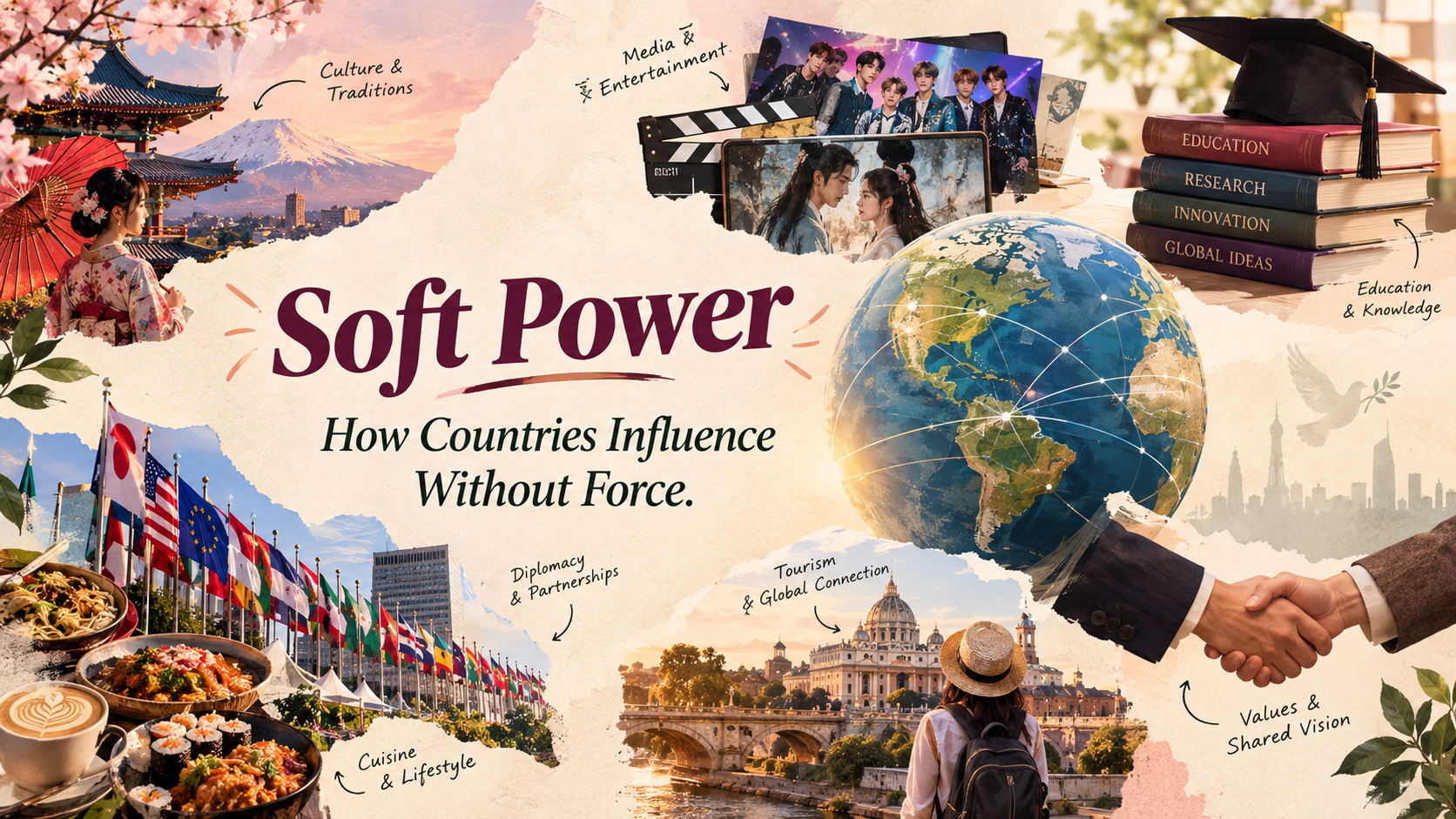
Picture a teenager in Cairo learning Korean. No army sent her there and no treaty required it. A television drama did. How does a country win admiration without firing a shot? The answer is soft power.
What Is Soft Power?
Soft power is the ability to get what you want through attraction rather than force or payment. Political scientist Joseph Nye coined the term in 1990 to contrast it with hard power, which relies on military strength and economic pressure. Nye identified three sources: culture, political values, and foreign policy. When all three appeal to outsiders, cooperation follows willingly.
Culture as a Weapon of Attraction
South Korea turned culture into an export industry. K-pop groups, K-dramas, and films like Parasite and Squid Game reached audiences worldwide, and fans followed them into Korean food, cosmetics, and language classes. Parasite even won the 2020 Oscar for Best Picture, the first non-English-language film to do so. The government backed this rise with funding, yet the appeal felt organic. The result is a national image built on creativity, not military strength.
Japan achieved similar reach through anime, manga, and cuisine. Studios like Studio Ghibli and series such as Naruto built loyal fandoms across continents, and the government's "Cool Japan" strategy encouraged the trend. Millions of people first met Japan through a cartoon or a bowl of ramen, and that friendly first impression shapes how they view the country afterward.
When Soft Power Fails
Soft power has limits. China has invested heavily in Confucius Institutes, media outlets, and infrastructure abroad, yet Pew Research Center surveys often show mixed views of China. Money buys visibility, not admiration. The United States saw its image slump after the Iraq war for the same reason. Soft power collapses when a country's actions contradict its image, and governments cannot fully control it, because culture spreads through people, not press releases.
Conclusion
The teenager in Cairo answers our question: countries win admiration when people choose to be drawn in. In a world of costly wars and nuclear weapons, attraction has become one of the most efficient forms of power. The leaders of the next century may not command the biggest armies. They will tell the best stories.
More from Writing
Deepfakes: A Double-Edged Sword in International Relations and Global Security:
Deepfakes have evolved from a digital nuisance into a real national security threat capable of fueling political and military crises. But could this same technology also help fight the misinformation it creates?
Read postFrom Cradle to Screens: Raising Tomorrow's Generation
Technology shapes childhood, but balance builds the future.
Read postThe New Oil: How Lithium and Rare Earths are Rewriting Global Power
For a century oil ruled the world, but now power has shifted to who controls lithium and rere Earth's processing.
Read post
Responses
Log in to comment and join the discussion.
Log in