Middle East after Gaza: The new regional order
normalization deals, Iran Saudia detente, and Turkey's role
Published 1 month ago
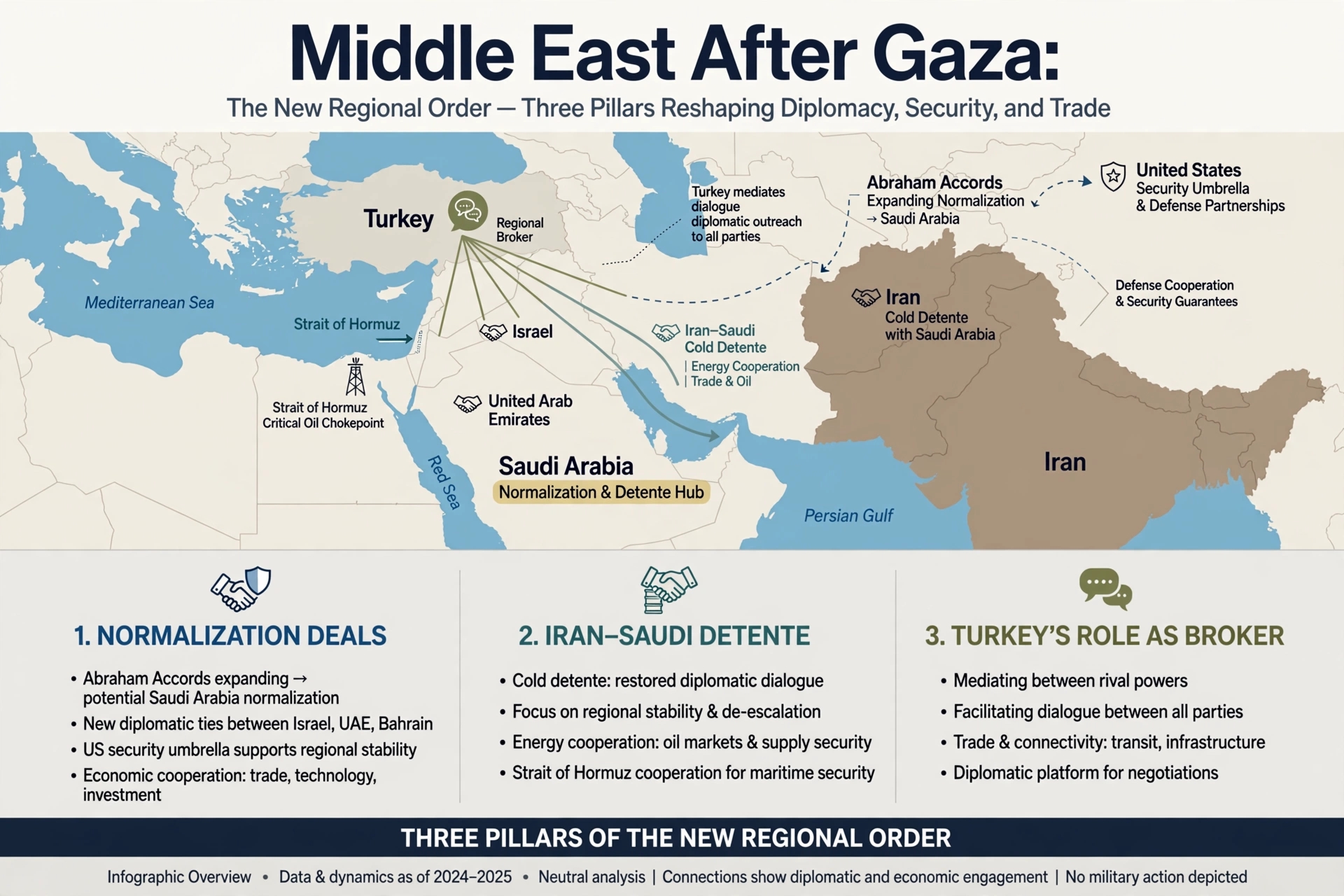
Since the 2023 breakout of Gaza war the Middle Eastern power dynamic has been completely altered as the conventional abilities of Hamas and Hezbollah largely weekend due to continues attacks by Israeli forces and fall of Assad regime followed by the recent US/Iran conflict forced the region towards political realignment which could pave the way for more regional tensions or conflicts.The 2023 Gaza conflict suspended the efforts for Arab Israel normalization instead it escalated and transformed the conflict into new direction which reawakend the old adversaries. However, US continue its efforts to expand Abraham accord by forcing Saudia Arabia, Pakistan, Turkiye and Qatar to recognize Israel, but Saudia Arabia clearly declared that the normalization would only be possible when people of Palestine got their statehood and self-determination. Pakistan while affirming its support for the establishment of the state of Palestine with Jerusalem as its capital completely rejected the proposal. While Turkiye which was once Israel's biggest trade partner suspended its diplomatic ties with Israel since 2024. The US also kept pursuing the Gaza reconstruction plan which consist of $2.45 billion international aid in exchange for the normalization. Israel consider it as the only way to bypass its diplomatic isolation particularly after the 2026 UNGA, where almost all the delegates walked out during Israeli PM Netanyahu's speech.
Wheresas Iran and Saudia reaffirmed their commitment to respect each other's sovereignty and refrain from interfering in each other's internal matters under the Iran-Saudia dètente brokered by China in 2023.As Iran cannot afford to be involved in two front war with its Gulf neighbors and Israel. While Riyadh are more interested to work for internal developments particularly the Vision 2030 and protecting its oil facilities from Houthi's strikes.
Despite ongoing tensions with Houthis attacking on Saudia's critical oil and energy infrastructure such as recent attacks on Khamis Mushait and Abha leading to the potential rise of global oil and energy crisis, both Saudia and Irani governments maintained back channel networks for negotiations and crisis management and a hotline to prevent Strait of Hormuz closure.
Between this political chaos Ankara emerged as a indispensable mediator consistently condemning Israeli aggression in Gaza and supporting the two state solution. While expanding its defense cooperation by exporting its drones and military technology to both Russia and Ukraine. In current geopolitical realignment of Middle East Turkiye seems to take Qatar's position as an active mediator in the region while simultaneously protecting its influence on Syria and Libya.
More from Writing
Deepfakes: A Double-Edged Sword in International Relations and Global Security:
Deepfakes have evolved from a digital nuisance into a real national security threat capable of fueling political and military crises. But could this same technology also help fight the misinformation it creates?
Read postFrom Cradle to Screens: Raising Tomorrow's Generation
Technology shapes childhood, but balance builds the future.
Read postThe New Oil: How Lithium and Rare Earths are Rewriting Global Power
For a century oil ruled the world, but now power has shifted to who controls lithium and rere Earth's processing.
Read post
Responses
Log in to comment and join the discussion.
Log inVery information ...